
5S Workplace Organisation with Modular Storage in Malaysia
5S is the foundation of lean manufacturing, and it is only as effective as the storage system that supports it. A Malaysian factory that invests in the right modular workstations, tool cabinets, perforated boards and parts storage will find 5S easier to implement — and far easier to sustain. This guide explains how each S maps to concrete storage choices on the shop floor.
What is 5S and why does it matter in Malaysia?
5S — Seiri (Sort), Seiton (Set in Order), Seiso (Shine), Seiketsu (Standardise) and Shitsuke (Sustain) — originated in Japanese manufacturing and is now standard practice in Malaysian factories, automotive plants and electronics assembly lines. The goal is a workplace where everything has a place, nothing is wasted, and problems are visible immediately. The result is faster changeovers, fewer lost tools, safer aisles and a shop floor that passes audit on inspection day.
What many Malaysian facilities discover is that 5S fails not because the team lacks discipline, but because the storage infrastructure does not support it. If there is no designated place for a torque wrench, it will end up on a bench, in a drawer or on the floor — and Sort and Set in Order become impossible. The right storage system makes 5S the path of least resistance.
Sort (Seiri): remove what does not belong
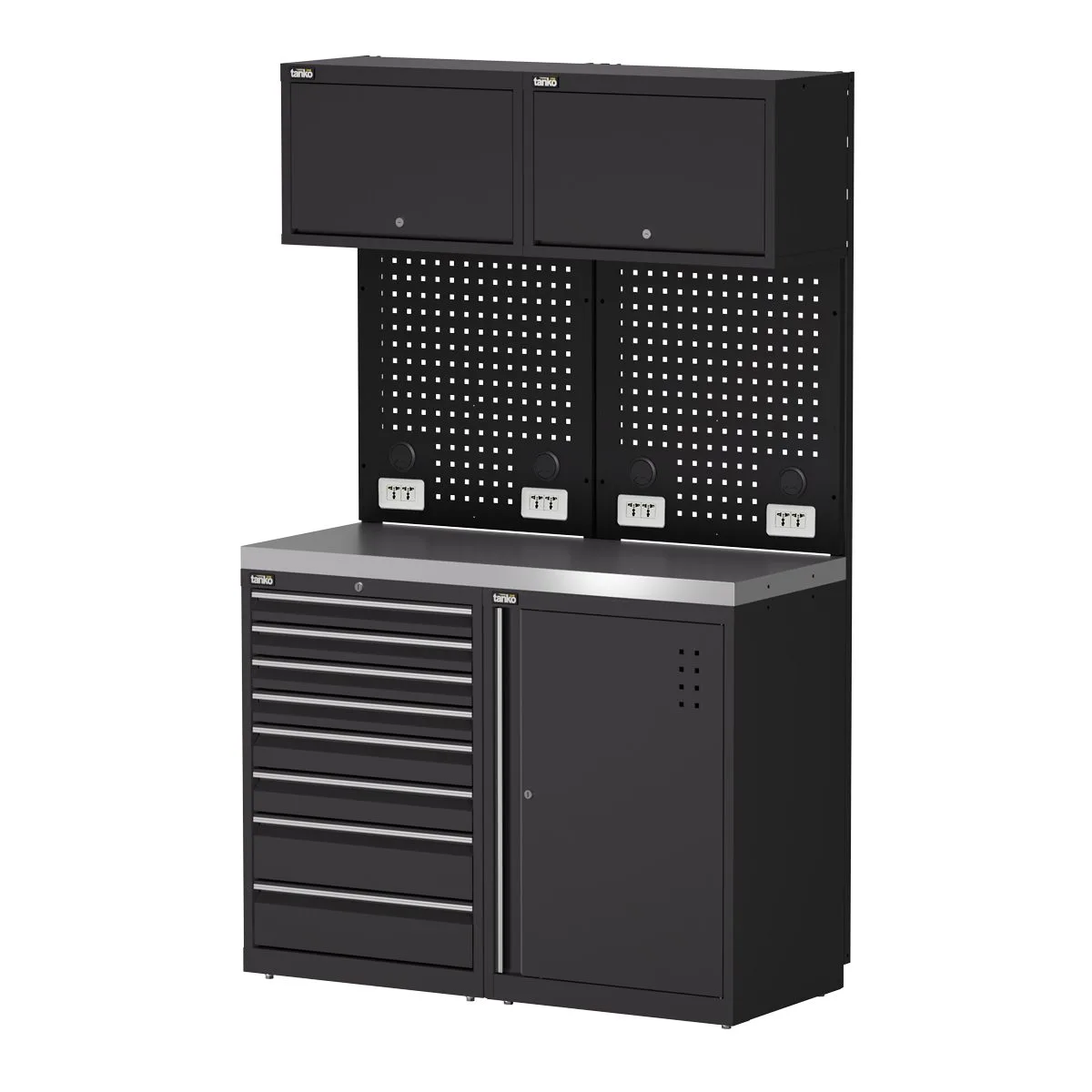
Sort means separating what is needed at a workstation from what is not. The practical storage question is: does this position have enough designated storage for the tools and parts that are needed, so that everything else is obviously out of place? A modular workstation with a drawer unit, pegboard and overhead shelf gives each item a home. When the drawer is full or the pegboard has no empty shadow, anything extra stands out — making Sort a daily habit rather than a quarterly campaign.
For factories in Penang, Johor and the Klang Valley running multi-shift operations, Sort also means controlling what crosses shift boundaries. Lockable tool cabinets assigned to technicians or shifts prevent tools from migrating between bays, and a locked lower cabinet on each workstation keeps consumables controlled rather than scattered.
Set in Order (Seiton): a place for everything
Set in Order is where storage design does the heavy lifting. The principle is simple: the most frequently used items are closest, at the right height, and visible without searching. In practice this means:
- Perforated boards and shadow boards behind or above the workstation for hand tools used every few minutes. A pegboard with foam shadow outlines makes a missing tool instantly visible — the empty shadow is the audit.
- Drawer units at the workstation for tools used a few times per shift. Drawers with dividers keep sockets, spanners and measuring instruments separated rather than jumbled.
- Lower shelving for bulk consumables and less frequently used items, within arm's reach but not occupying prime work-surface space.
- CNC tool storage positioned between machining centres so BT-40, HSK and ISO holders are organised by station rather than piled in a drawer.
The layout should follow the work sequence, not the storage catalogue. Walk through the task at each position and place tools in the order they are picked up — this cuts motion waste more than any other single change.
Shine (Seiso): clean to inspect
Shine is not housekeeping for its own sake — it is inspection by cleaning. A clean workstation reveals leaks, worn parts, loose fasteners and chip buildup before they become failures. Storage design supports Shine when surfaces are smooth, drawers are removable for cleaning, and perforated boards are open rather than enclosed. Stainless steel worktops in food, pharma and laboratory environments are chosen partly because they wipe clean and reveal contamination instantly.
In Malaysian conditions — high humidity, occasional dust, and coolant or oil in machining areas — Shine also means choosing materials that resist corrosion. Powder-coated steel frames, stainless steel tops in wet areas, and drawer slides that can be wiped down all reduce the maintenance burden of keeping a position audit-ready.
Standardise (Seiketsu): make the best practice the default
Standardise means codifying what Sort, Set in Order and Shine look like at each position, so every shift and every operator follows the same layout. This is where modular storage earns its keep: because workstations, drawer units and pegboards are configurable, a standard layout can be replicated across every position in a production line. When Position 3 and Position 7 have the same drawer layout and the same shadow board, training is faster, problems are easier to spot, and temporary workers can be productive in minutes.
For Malaysian facilities expanding or reconfiguring lines, standardised modular storage also means that when a new position is added, the storage spec is already defined — no redesign required. The Tanko workstation system is built around this idea: a common frame accepts drawer units, pegboards, shelves, lighting and power in consistent positions.
Sustain (Shitsuke): make it stick
Sustain is the hardest S, and it is where most 5S programmes quietly stall. The key is to make the organised state easier than the disorganised state. If returning a tool to its shadow takes two seconds and leaving it on the bench takes one, the bench will win. If the drawer is labelled, the divider fits the tool, and the shadow board is at the right height, returning the tool becomes automatic.
Audit and visual management support Sustain: daily 5S checks, a leader-led walk, and a board that shows each position's status. But the foundation is always the storage itself. A facility that buys cheap, non-configurable storage and then tries to enforce 5S through discipline alone is fighting an uphill battle. A facility that invests in the right modular storage finds that 5S sustains itself because the system makes it the natural way to work.
Direct answer: The most effective 5S storage setup for a Malaysian production line is a modular workstation with a drawer unit for medium-use tools, a perforated shadow board for high-use hand tools, and lower shelving for consumables — all standardised across positions. Pair this with lockable tool cabinets for shift-assigned tools and CNC tool storage between machining centres.
Getting started with 5S storage
If you are setting up a new line or reorganising an existing one, start with one pilot position. Walk the task, list every tool and part used, and design the storage around that list — not around what is in the catalogue. Once the pilot position works and the team accepts it, replicate the standard across the line. Request a quote with your position count and task list, and we will recommend the workstation, drawer and pegboard configuration that makes 5S the default rather than the goal.
Frequently asked questions
What storage do I need for a 5S production line in Malaysia?
A modular workstation with a drawer unit for medium-use tools, a perforated shadow board for high-use hand tools, and lower shelving for consumables. Add lockable tool cabinets for shift-assigned tools and CNC tool storage for machining areas.
How does a shadow board support 5S?
A shadow board uses foam or painted outlines to show exactly where each tool belongs. A missing tool leaves an empty shadow, making the problem instantly visible — this supports Set in Order and makes daily audit automatic.
Can 5S storage be standardised across different positions?
Yes. Modular workstation systems use a common frame that accepts drawer units, pegboards, shelves, lighting and power in consistent positions, so the same layout can be replicated across every position on a line.
How do I start implementing 5S storage in my factory?
Start with one pilot position. Walk the task, list every tool and part used, and design storage around that list. Once the pilot works and the team accepts it, replicate the standard across the line.
Sourcing in Malaysia? Primaxs is the exclusive Malaysia distributor for Tanko industrial storage. Browse the product range or request a quote for your workshop or factory.