
Workbench Top Material Guide for Malaysian Workshops
The workbench top is the surface you touch every day, and choosing the wrong material is a mistake you feel for years. Laminate marks under heavy tools, rubber degrades near oil, steel rings under hammering, and stainless steel costs more but is essential in food and cleanroom environments. This guide matches each top material to the applications where it belongs in Malaysian workshops and factories.
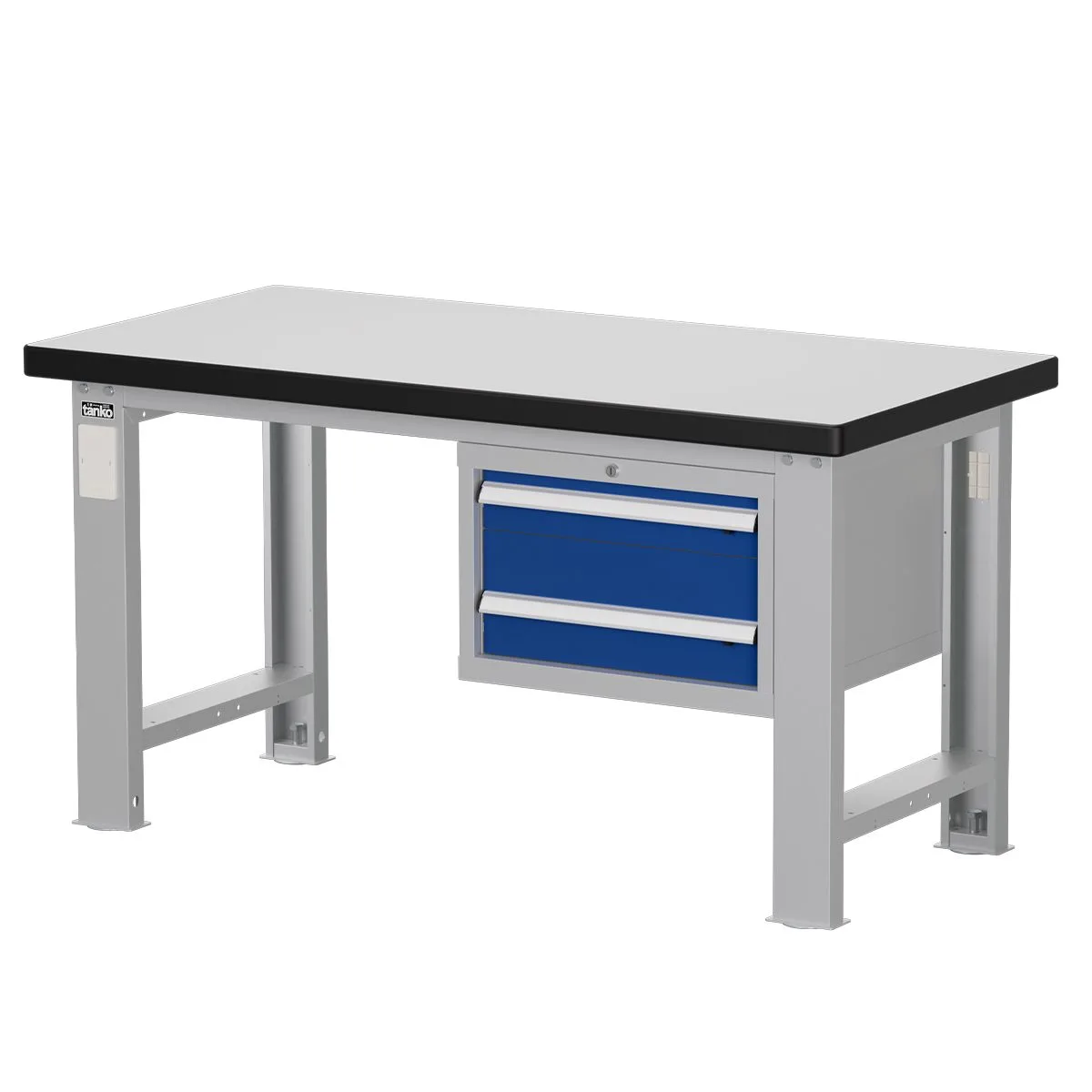
The five common workbench top materials
Tanko workbenches are available with several top options, and each is engineered for a different duty. The choice comes down to three questions: what kind of work happens on the surface, what contaminants are present, and what level of impact and abrasion will the top see?
Laminate tops
Laminate (often called Formica or high-pressure laminate) is a smooth, non-porous surface that resists stains and is easy to wipe clean. It is the standard choice for light assembly, inspection, packing and administrative work where the surface needs to be clean and flat but does not take heavy impact. In Malaysian electronics assembly lines in Penang and Johor, laminate tops are common because they do not generate static when paired with an ESD mat, and they provide a smooth reference surface for measuring and inspection.
What laminate is not: it is not a fabrication surface. A hammer, a sharp edge or a heavy workpiece dropped on it will mark or chip the surface. If your work involves clamping, hammering or heavy parts, choose rubber or steel instead.
Rubber tops
Rubber tops — usually a dense rubber mat bonded to a substrate — absorb impact and dampen vibration. They are the standard choice for mechanical assembly, maintenance bays, and any position where parts are placed down with force. A rubber top protects delicate parts from scratching, reduces noise when steel parts are set down, and provides a non-slip surface. In Malaysian automotive workshops and maintenance departments, rubber tops are the default because they survive daily use with hand tools and metal components.
Rubber's weakness is oil and solvent exposure. In positions where coolant, cutting fluid or solvent is regularly present, rubber can swell or degrade over time. For those environments, steel or stainless steel is the better long-term choice.
Solid wood tops
Solid wood tops — typically beech or similar hardwood, laminated into staves — are a traditional workshop surface. They are kinder to edge tools than steel, absorb some impact, and can be re-sanded when marked. Wood tops suit general workshop, light fabrication and prototyping where the surface takes occasional abuse but not continuous heavy fabrication. In Malaysian small factories and contract workshops, wood tops are a versatile middle option.
Wood's weakness is moisture. In Malaysia's high humidity, an unsealed wood top can swell or warp if it gets wet regularly. Tanko wood tops are sealed for industrial use, but in wet or outdoor positions, steel or stainless is more durable.
Steel tops
Steel tops — solid steel plate, usually 3–5 mm or thicker — are the heavy-duty option. They resist impact, weld spatter, oil and abrasion, and they provide a grounded work surface for welding. Steel tops are the standard for fabrication, welding bays, heavy maintenance and tool rooms where the surface is part of the work, not just a place to put things. In Malaysian fabrication shops in Shah Alam, Pasir Gudang and Penang, steel-top benches are the workhorses.
Steel's trade-offs: it is noisy when parts are set down, it can mark soft materials, and it conducts cold and heat. For assembly or inspection work, steel is usually overkill — and a rubber or laminate top is more comfortable to work on.
Stainless steel tops
Stainless steel tops (typically 304 grade) are the premium option for food processing, pharmaceutical, laboratory and cleanroom environments. They are non-porous, corrosion-resistant, and can be sanitised to standards that no other top material can meet. In Malaysian food processing plants, pharmaceutical facilities and laboratories in KL, Penang and Johor, stainless steel tops are often specified by regulation or audit requirement.
Stainless steel is more expensive than the other options, and it is not necessary in standard industrial positions. Choose it when hygiene, corrosion resistance or cleanroom compliance is the requirement — not when a steel or rubber top would do the job.
Matching top material to your application
| Application | Recommended top | Why |
|---|---|---|
| Electronics & EMS assembly | Laminate + ESD mat | Smooth, flat, non-static when grounded |
| Automotive maintenance bay | Rubber | Impact absorption, part protection, non-slip |
| Fabrication & welding | Steel | Impact, spatter and oil resistance; grounded surface |
| Food & pharma production | Stainless steel | Non-porous, sanitizable, corrosion-resistant |
| Laboratory & cleanroom | Stainless steel or laminate | Hygiene and chemical resistance |
| General workshop & prototyping | Wood or rubber | Versatile, kind to tools, re-surfaceable |
| Inspection & quality control | Laminate | Flat, stable, easy to clean |
| Packing & dispatch | Laminate or wood | Clean, durable, cost-effective |
Malaysian climate considerations
Malaysia's high humidity and occasional heavy rain affect top material choice in practical ways. Wood tops need sealing and should avoid continuously wet positions. Steel tops should be powder-coated or stainless to resist rust in humid storage areas. Rubber tops should be inspected for oil degradation in machining environments. Stainless steel, as expected, handles humidity best — which is one reason it is preferred in food and pharmaceutical facilities nationwide.
Direct answer: For most Malaysian workshops, a rubber top is the best all-rounder for maintenance and assembly, a steel top is required for fabrication and welding, and a laminate top is right for light assembly and inspection. Choose stainless steel only when hygiene or corrosion resistance is a regulatory requirement.
Configuring your workbench
The Tanko workbench range offers these top materials across multiple widths and duty ratings, and most models can be configured with drawer units, pegboards, lighting and power. If you are unsure which top suits your position, describe the work and the environment and we will recommend the right configuration. Request a quote with your application details and we will confirm the top material, size and options for each position.
Frequently asked questions
Which workbench top is best for automotive workshops in Malaysia?
Rubber tops are the standard choice for automotive maintenance bays — they absorb impact, protect parts from scratching, and provide a non-slip surface for daily hand-tool use.
Can I weld on a laminate workbench top?
No. Laminate will mark, burn or chip under weld spatter and heavy impact. For welding and fabrication, choose a steel top that resists spatter and provides a grounded work surface.
Is stainless steel worth the extra cost for a general workshop?
Usually not. Stainless steel is premium-priced and is justified when hygiene, corrosion resistance or cleanroom compliance is required — food, pharma, laboratory. For general industrial work, steel or rubber tops are more cost-effective.
How does Malaysia's humidity affect workbench top choice?
High humidity favours sealed tops. Wood should be sealed and kept from continuous moisture; steel should be powder-coated or stainless; stainless steel handles humidity best and is preferred in food and pharma facilities.
Can I change the top material on an existing Tanko workbench?
Tanko workbenches are configured at order time with the chosen top. For existing benches, contact us to discuss whether a top replacement or re-surfacing is possible for your model.
Sourcing in Malaysia? Primaxs is the exclusive Malaysia distributor for Tanko industrial storage. Browse the product range or request a quote for your workshop or factory.