Perforated Boards & Shadow Boarding for Tool Control
The cheapest productivity upgrade on most shop floors is a perforated board done properly. A pegboard puts every hand tool within reach and, when set up as a shadow board, makes a missing tool obvious at a glance. For Malaysian workshops and lines, it is the backbone of visual tool control.
_2.webp)
What is a perforated board?
A perforated board (pegboard) is a steel panel with a regular hole pattern that accepts hooks and holders. It mounts on a wall or the back panel of a workbench and turns a flat vertical surface into organised, visible tool storage. Tanko's perforated board range includes standard and stainless-steel boards, louvred panels, and a full set of hooks and specialist holders.
Pegboard vs louvred board vs bin panel
| Panel type | Best for |
|---|---|
| Perforated board (pegboard) | Hand tools on hooks — the general-purpose choice |
| Louvred board | Hanging plastic bins for small parts and fasteners |
| Stainless perforated board | Wet, food-contact or cleanroom areas |
Direct answer: Use a perforated board with hooks for hand tools, a louvred board for hanging parts bins, and stainless steel where there is water or food contact. Turn any board into a shadow board by outlining each tool so gaps show at a glance.
Choosing hooks and holders
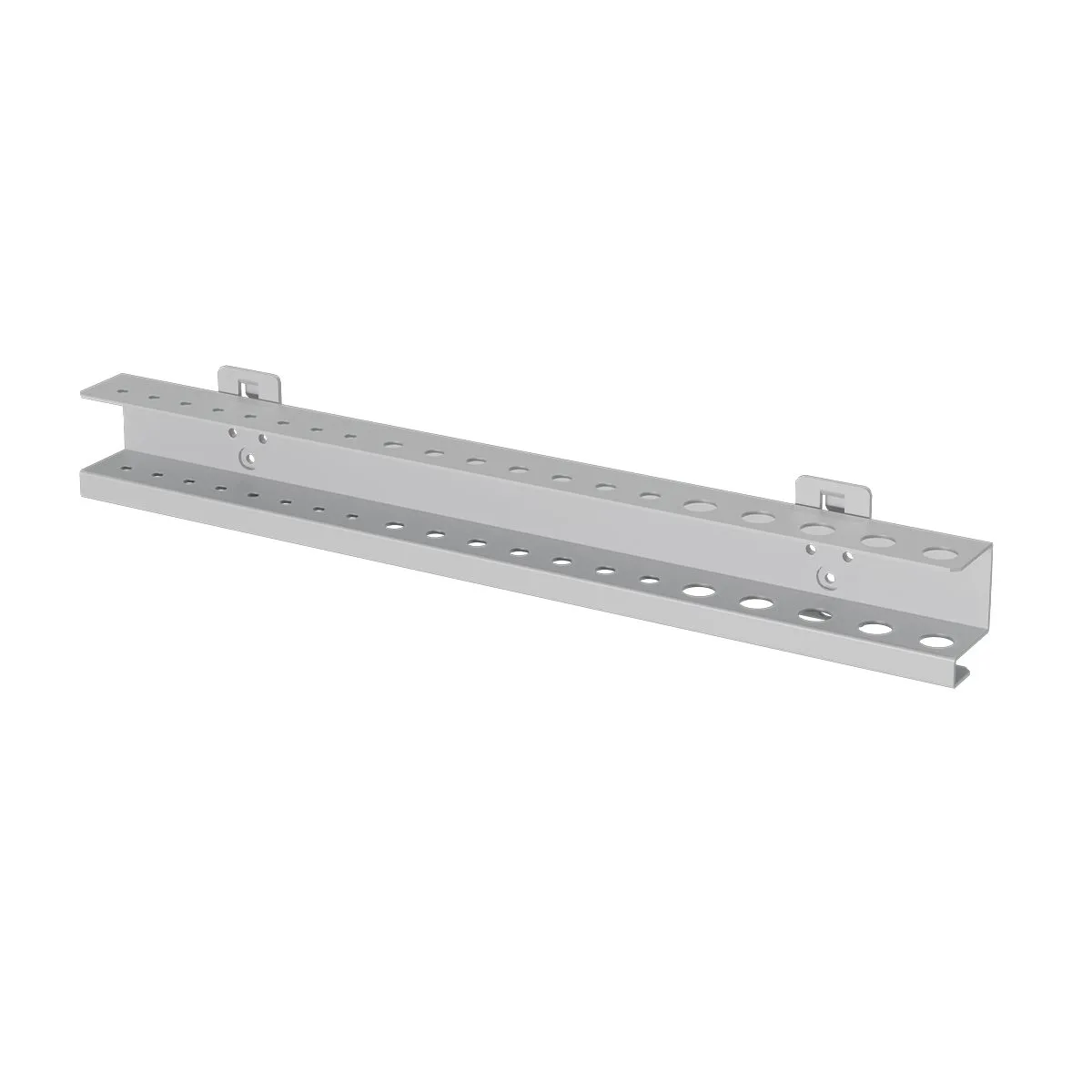
The board is only as useful as the hooks on it. Tanko offers steel, plastic and stainless-steel hooks plus specialist holders for drills, screwdrivers, T-handles, wrenches, clips and bottles. Match the holder to the tool so each item sits securely and returns to the same place every time.
How to set up a shadow board
- Select the tools that belong at this station — only what is used here.
- Lay them out on the board in reach order, most-used at centre.
- Outline each tool so its position is marked.
- Fit the right hook or holder at each outline.
- Label where useful, especially for shared stations.
The result: anyone can see what belongs, what is missing, and where to return a tool — without asking.
Why it pays off
- Less tool loss — a missing tool is visible immediately, not at month-end.
- Faster changeovers — tools are found and returned in seconds.
- Cleaner audits — 5S becomes a visual check.
- Safer benches — tools off the work surface, less clutter.
Shadow board layout rules that survive an audit
Most shadow boards look good on the day they go up. The ones still working a year later follow a few rules:
- Frequency decides height. The tools used every hour go in the centre of the board, between waist and shoulder height. Rarely used or heavy tools go low; nothing heavy goes above head height.
- Group by task, not by type. Put the tools for one job together in the order they are used, so an operator's hand moves in one direction.
- Leave space between outlines. About a finger's width (roughly 20mm) between tools lets each one come off without knocking its neighbour.
- Make the gap obvious. Use a board colour that contrasts with the tools. Tanko boards come in grey, white, red, blue and black: a white or grey board behind dark tools, or one colour per zone, such as red for emergency and safety equipment.
- One tool, one home. Every outline gets exactly one tool and the hook or holder that fits it. Duplicates get their own outlines.
- Label the size, not just the name. "17mm spanner" saves a search that "spanner" does not.
- Photograph the finished board. The photo becomes the standard for the 5S audit and for rebuilding the board if outlines wear.
Painted outline, vinyl or foam?
| Method | Suits | Watch out for |
|---|---|---|
| Painted or marker outline on a steel pegboard | Wall boards and workbench panels; cheapest to change when the tool set changes | Re-mark outlines when tools are added or moved |
| Vinyl shadow decals | Sharp, consistent outlines across many identical stations | Needs a clean, dry surface to stay stuck in humid areas |
| Cut foam inserts | Inside drawers of a tool cabinet, for precision or calibrated tools | Not for wall boards; foam traps dirt and oil over time |
On a steel pegboard the outline method can change while the board and hooks stay. Because Tanko keeps one hole pitch across the range, a layout can be reworked without redrilling or buying a new board. For board sizes, hooks and Ringgit prices, see the metal pegboard guide.
Do shadow boards reduce tool loss?
Yes, because they change when a missing tool is noticed. Without a board, a missing torque wrench is found when the next job needs it, often days later and with no idea who had it last. With a board, the empty outline shows at the end of the same shift, while the people who used it are still on site. The same visibility drives the other gains: less time hunting for tools, faster changeovers, and benches kept clear. It also matters for safety where a tool left inside a machine, vehicle or aircraft is a hazard; that is why foreign-object control programmes rely on shadow boards.
Pricing note: Board-and-hook pricing depends on panel size and the hooks you need. Tell us the station and tools and we'll quote a board kit.
Frequently asked questions
What is a shadow board for tools?
A shadow board is a tool board where each tool has a marked outline, its “shadow”, so every tool has one home and a missing tool leaves a visible gap. It is a core 5S visual-management practice.
Do shadow boards reduce tool loss?
Yes. An empty outline shows a missing tool at the end of the same shift, while the people who used it are still on site, instead of days later when the next job needs it.
What is the difference between a perforated board and a louvred board?
A perforated board (pegboard) has a hole pattern that accepts hooks for hanging hand tools. A louvred board has angled slots designed to hold plastic parts bins. Use a pegboard for tools and a louvred board for small-parts bins.
How do I make a shadow board?
Select the tools that belong at the station, lay them out in reach order, outline each tool on the board, fit the matching hook or holder at each outline, and label where useful. A missing tool then leaves a visible gap.
Should I use a stainless-steel pegboard?
Use stainless steel where there is water, chemicals or food contact — for example in food processing, labs or wet areas. For general workshop use, a standard powder-coated perforated board is sufficient.
Where can I buy pegboards and hooks in Malaysia?
Primaxs supplies the full Tanko range of perforated boards, louvred boards and hooks in Malaysia, including specialist holders for drills, screwdrivers, wrenches and more.
Sourcing in Malaysia? Primaxs is the exclusive Malaysia distributor for Tanko industrial storage. Browse the product range or request a quote for your workshop or factory.